
The Security and Authenticity of the Authorized Supply Chain
Rochester Electronics’ 100% Authorized, traceable, and certified solutions
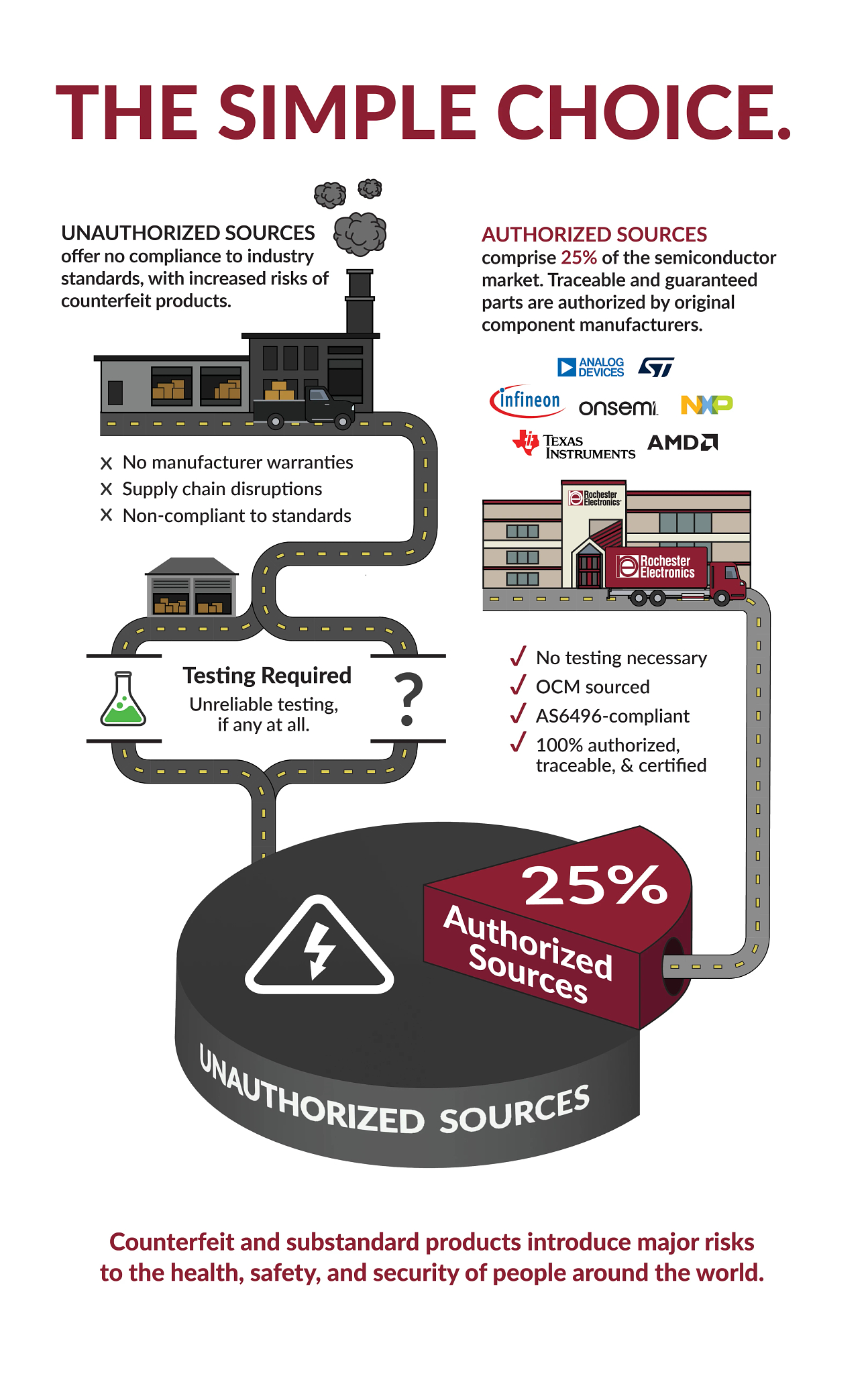
Did you know authorized distributors accounted for just 25-29% of global semiconductor revenue in 2022, with most sourcing coming from non-authorized channels? These non-authorized channels make up the “gray market.”
Unauthorized or 'gray market' semiconductor distributors function without official agreements with original component manufacturers (OCMs). They often obtain products through various channels, such as excess inventory, outdated stock, or counterfeit devices. Dealing with unauthorized distributors poses risks of receiving inferior or counterfeit products. Additionally, unauthorized channels cannot offer manufacturer-supported warranties.
What are the semiconductor distribution channels?
- Authorized distributors: Authorized distributors provide a supply source directly from the OCMs and are fully authorized by them. They are traceable and certified.
- Non-authorized/independent distributors: Independent distributors lack direct authorization and cannot provide a secure supply chain. While some may offer component testing, there is still no guarantee of the product's authenticity.
- Non-authorized dealers: Non-authorized dealers purchase components from various sources and resell them, posing the least safe option for customers due to the lack of quality guarantees. This also exposes customers to an increased risk of purchasing counterfeit devices.
Purchasing from non-authorized sources can lead to the following risks:
- No access to manufacturer-backed warranties or technical support
- An inconsistent supply chain and an increased risk of supply chain disruptions.
- There is no guarantee of compliance with industry standards, which increases the risks of substandard and counterfeit products and customer financial and reputational risks.
The risks posed by counterfeit devices are very real and growing. According to North Carolina State University, counterfeiting has grown from a $30 billion trade problem in the 1980s to one that now exceeds $600 billion in trade.
The 2023 ERAI report shows an increase in reported counterfeit and nonconforming parts, and this number has only increased in the past two years despite a decline in global semiconductor sales.
The consequences to customers in allowing substandard or counterfeit products to enter the supply chain include:
- Reduced production yields and increased rework
- The introduction of malware or changes that enable third parties to access the software
- Increased in-service failures and reduced reliability
- Heightened risks and financial liability associated with catastrophic system failure
- Potential reputational damage
Customers are not the only ones threatened; lost revenue and, more seriously, reputational damage also impact OCMs.
The true number of counterfeits cannot be known. While self-reporting tools, such as the Government-Industry Data Exchange Program (GIDEP) exist, customers lack the incentive to admit to purchasing failures. For customers to protect themselves, it is safer to assume that all semiconductors sourced outside authorized channels are potential counterfeits. Each counterfeit poses risks to the user.
- Re-marking: In cases of re-marked products, the process of re-etching the original external markings with aggressive chemicals or mechanical grinders can result in internal bond or substrate damage. The chemical residues from the cleaning process slowly enter and contaminate re-marked devices, causing bond-pad or bond-wire failures. The re-mark printing is exceptionally deceptive and may not be identified during AS6081 visual testing. Basic product testing under AS6171 will not identify performance differences for parts re-marked as higher-spec products. Nor will they catch components that narrowly fail the Original Component Manufacturer’s (OCM) tests but are recovered illegally.
- Recovery Process: The process of recovering used semiconductors from old PCBs can also result in catastrophic heat and mechanical damage. Recovering ICs from PCBs is the final step in a lengthy process that involves prior usage and an unregulated storage environment. Exposure to excessive humidity, water, and salt is routine. The final process of replating and reforming leads introduces further ESD, thermal, and mechanical risks. This process can produce superficially authentic used products with questionable reliability.
- Identifiable Surplus Stock: Traceability without authorization provides no guarantee of quality, reliability, or a legitimate product. Often regarded as a no-risk option, unauthorized semiconductor storage and handling conditions are uncontrolled. ESD damage and moisture ingress are equally disastrous to the reliability of authentic surplus stock semiconductors. In times of desperate procurement, the unauthorized space provides perfect cover for component-source mixing and increased counterfeit risk.
According to Electronic Sourcing North America’s 2024 Reader’s survey results, semiconductor buyers' primary concerns revolve around product quality, authenticity, counterfeit components, lead times, obsolescence, and sourcing end-of-life (EOL) parts. All these concerns can be addressed by exclusively engaging with fully authorized channels.
Why purchase from 100% authorized semiconductor suppliers?
- Guaranteed product authenticity and reliability
- Manufacturer-backed warranty and support
- Avoiding the risks of counterfeit components
- Adherence to industry quality standards and certifications
- Fully traceable supply chain
- A safe stock of obsolete components
Many customers assume that unauthorized or grey market sources are the only option once the original manufacturer stops producing a component. However, this is not the case.
When an original component manufacturer (OCM) discontinues a product, customers often have a final buying opportunity offered directly from the OCM. Often, customers do not want capital tied up in a large amount of stock, can’t fund a substantial purchase, or lack sufficient storage facilities. When their supply is depleted, they must find a new supplier, with limited safe options for sourcing a product after the “Last Time Buy” (LTB). A supplier with an established EOL transition path, such as Rochester Electronics, offers the hope of risk-free ongoing authorized stock and production.
SAE's AS6496, developed by the Society of Aerospace Engineers, is a robust anti-counterfeiting measure that sets guidelines to combat counterfeit products within the authorized distribution supply chain.
Authorized after-market suppliers and manufacturers (as called out in the US-DoD DFARS), such as Rochester Electronics, comply with AS6496. The OCM authorizes them to provide traceable and guaranteed products, and no quality or reliability testing is required because the parts are only sourced from the OCM.
Providers who are not fully authorized may market themselves as AS6171/4-compliant. This indicates they follow standardized inspections and test procedures but may have minimum training and certification requirements to detect suspicious or counterfeit components. If AS6171 testing is being done, the product is not being tested to the original OCM test program. OCM test programs test significantly beyond datasheet parameters and are meant to filter products for no failures even when millions of units are sold. AS6171 testing is not equivalent to OCM testing.
The risk-free option of an AS6496 authorized after-market supplier should always be the first choice.
Rochester Electronics offers an authorized continuous source of supply with over 15 billion devices in stock encompassing 200,000-part numbers, providing the world’s most extensive range of EOL and the broadest range of active semiconductors.
Over 10 billion of Rochester’s in-stock devices are classed as EOL by the original manufacturer, from which the product is directly supplied. Rochester is well-positioned to offer a continuous source of supply for applications where the product lifecycle extends the active availability of a device. Rochester’s factory-direct offerings negate the need for expensive redesign, requalification, and recertification and avoid the risk of sourcing hard-to-find products on the open market. Components are 100% authorized, traceable, and guaranteed direct from the OCMs. As a result, Rochester can offer the original component warranties and guarantees.
As a licensed semiconductor manufacturer, Rochester offers ongoing solutions using information and technology transferred directly to Rochester from the OCM. Rochester utilizes the original manufacturer’s die and fab processes, matching the original designs, assembly solutions, and test protocols. The resulting product is 100% certified, licensed, guaranteed, and sold with full approval under the original manufacturer’s part number.
Rochester’s licensed manufacturing solutions are current date code and guaranteed to perform according to the original datasheet. Our team is ready to assist customers in navigating strict regulatory requirements. Rochester has manufactured over 20,000 device types, and with over 12 billion die in stock, it has the capability to manufacture over 70,000 device types.
To best support the customer’s ongoing need to extend the life of semiconductor products, Rochester continues to invest in design solutions, ensuring your system software does not need to change while simultaneously creating drop-in hardware solutions that minimize new qualification expenses. Rochester specializes in the authorized porting of products from original fab processes but offers form, fit, and functional replacements. Regardless of the design solution from Rochester, no errata are introduced, and no system software changes are needed.
Rochester Electronics is registered to manufacture ITAR products. Rochester is certified in ISO 9001, Automotive IATF 16949, AS9120, and ISO 14001 (environmental management). It is also QML MIL-PRF-38535 certified for Class Q and V for high-reliability defense and aerospace applications.
When facing critical component EOL and obsolescence for long-life applications, think Rochester Electronics; the 100% AUTHORIZED experts in providing dependable and trusted “long-term” semiconductor lifecycle solutions.
Learn more about the power of authenticity and reliability
Six steps for planning for and avoiding the costs of obsolescence
How to avoid the risks of counterfeit semiconductors
Read anti-counterfeit white paper: Why purchase from fully authorized sources
Manufacturers


